|



The
Aurora Borealis, or Northern Lights, are an integral part of life in the
Arctic. Many nights the sky is ablaze with shimmering dancing colors
that seem to take on a life of their own. I am very fortunate, in that,
I work in an environment that while scientific, allows me to come in
contact with this most beautiful aspect of nature. I work in a research
facility that deals directly with the Aurora and it's effects.

The
Northern Lights are an ionospheric phenomenon that is unparalleled in
nature for beauty and grace. Auroras occur around Earth's north and
south geomagnetic poles in regions known as auroral ovals. Southern
auroras are called 'aurora australis;' northern ones, 'aurora borealis.'
The aurora is higher in the atmosphere than the highest jet plane flies.
The lowest fringes are at least 40 miles above the Earth, while the
uppermost reaches of the aurora extend 600 miles above the Earth. The
space shuttle flies near 190 miles altitude.
Although there are stories about the aurora seeming to reach down into
the clouds or to the tops of mountains, these are either illusions or
some phenomenon other than the aurora. Only astronauts can fly through
the aurora! Some people believe that the aurora makes sound that
accompanies the ripples and flow of the light. If the aurora does make
sound, the sound would have to be generated here on Earth by some
electromagnetic effect. Any noise generated by the aurora would take a
long, long time to travel all the way to Earth, and the air up by the
aurora is much too thin to carry sound. So does the aurora make noises?
Nobody knows for sure!
Auroras occur because Earth's magnetic field interacts with the solar
wind, a tenuous mix of charged particles blowing away from the sun. This
wind from the sun sweeps by Earth in the interplanetary magnetic field
which is produced by the sun. We are protected from the solar wind's
direct effects by Earth's comet-shaped magnetosphere, where the Earth's
magnetic field is distorted by the interplanetary magnetic field and the
solar wind. The electrical energy generated by the charged particles
blowing across the Earth's magnetic field send charged particles down
into the Earth's upper atmosphere. Auroral light is similar to light
from color television. In the picture tube, a beam of electrons
controlled by electric and magnetic fields strikes the screen, making it
glow in different colors, according to the type
of chemicals (phosphors)
that coat the screen. Auroral light is the from the air glowing as
charged particles, particularly electrons, rain down along the Earth's
magnetic field lines. The color of the aurora depends on the type of
atom or molecule struck by the charged particles. Each atmospheric gas
glows with a particular color, depending on its electrical state
(ionized or neutral) and on the energy of the particle that hits the
atmospheric gas. High-altitude oxygen, about 200 miles up, is the source
of the rare, all-red auroras. Oxygen at lower altitudes, about 60 miles
up, produces a brilliant yellow-green, the brightest and most common
auroral color. Ionized nitrogen molecules produce blue light; neutral
nitrogen glows red. The nitrogens create the purplish-red lower borders
and ripple edges of the aurora. Auroral displays vary from night to
night and during a single night. Usually, if sun-earth conditions
produce an auroral sub storm, a diffuse patch of glowing sky will be seen
first, followed by a discrete arc that brightens, perhaps a
thousand-fold in a minute. As an arc moves toward the equator, new ones
may form on its pole ward side. Appearing within arcs are upward-reaching
striations aligned with the magnetic field, giving the impression of
curtains of light. Ripples and curls dance along the arc curtains and
pulsating patches of light may appear in the morning hours.
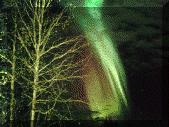
So,
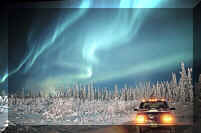
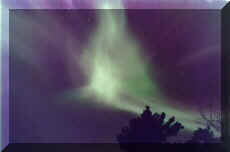
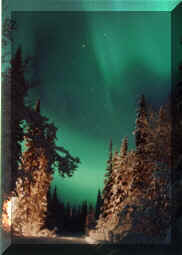
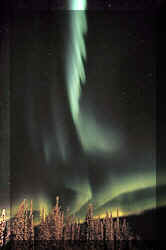
without any further comments on my part, we will get right to the
photographs. I hope you enjoy them, some were taken from the "Dreamwevr"
website and some were taken by a co-worker at the research facility
where I work.......enjoy!

|