|
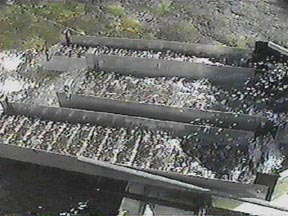
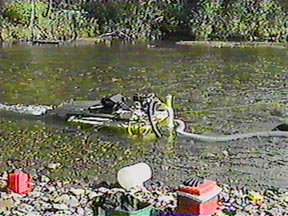
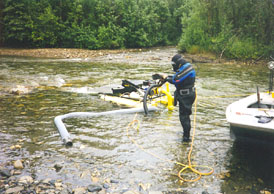
This is the business end of my 5" triple sluice dredge. For those of you who have never seen one, the bulk of the water and large rocks travel down the center sluice. The smaller rocks and diminished water flow travel down the two side sluices where the gold can get out of the main water flow and be recovered easier. Water and rocks are sucked up through a 5' hose and deposited in the header box which then classifies the mixture into it's respective sluices. This dredge is powered by an 8 hp Tecumseh engine with a 'Hookah' air system for breathing underwater. All of this is mounted on floats. Below are two pics of what the whole system looks like when it is assembled.
A
dry suit is needed to work in these extreme cold water conditions. These
suits are extremely warm and water-tight. Full face masks help make for
a very warm setup. In the pic on the right you can see a small creek
that comes into this river at this point. The creek is smooth swept
bedrock and holds no gold, but it does provide a place where gold will
drop when the main river is in flood because it creates an effective
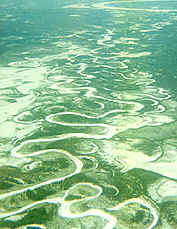
'low pressure' area. The serpentine nature of these rivers makes
prospecting them different from places like California where the grade
is steep. Then
one time when the river was extremely low due to no rain, I was able to
get out in what would be the deepest fastest part in normal conditions.
What a surprise when I started getting not only more gold, but small
nuggets also. It was tough working this spot because while the water was
low, it was also fast. Fortunately it was not very deep and I could lay
down and brace my feet against some larger rocks to stay in place. The
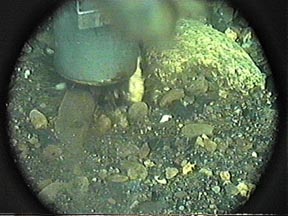
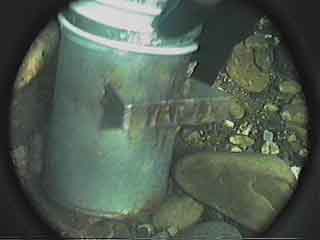
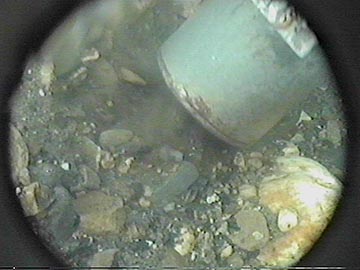
river Below are some photos that were taken by my friend Jessie Atencio while I was dredging. They were shot with a video camera that I had installed a rubber hose coupling on and inserted a glass in one end, the other end was hose clamped to the camera. This set-up would also let the lens auto focus. You could get the lens underwater just far enough to take some pictures. You can see the actual videos of this on Jessie's website, which is one of the better Alaskan Prospecting sites on the web.
Alaska Gold Forum
The author is a member of
Copyright 2004
Alaska Internet Resources |

 Here
the grade is very flat and rivers tend to move slowly even in flood
stage. In most rivers in California you look for gold on the inside
bend. But I have found that in this river the heavier gold will be right
in the main channel, which in this pic is over close to the creek and on
the outside bend of the river. At this point, the river channel is swept
bedrock but also very jagged and broken, it holds the gold very well.
For those who may not be familiar with the 'serpentine' nature of rivers
in Alaska I am posting a photo of what they look like from the air to
give you a prime example. The gold moves differently in this kind of
river and what you have learned about how gold moves is not true in
rivers like this. I spent a lot of time prospecting the inside bends
here. I got a little gold, but it was mostly fine stuff.
Here
the grade is very flat and rivers tend to move slowly even in flood
stage. In most rivers in California you look for gold on the inside
bend. But I have found that in this river the heavier gold will be right
in the main channel, which in this pic is over close to the creek and on
the outside bend of the river. At this point, the river channel is swept
bedrock but also very jagged and broken, it holds the gold very well.
For those who may not be familiar with the 'serpentine' nature of rivers
in Alaska I am posting a photo of what they look like from the air to
give you a prime example. The gold moves differently in this kind of
river and what you have learned about how gold moves is not true in
rivers like this. I spent a lot of time prospecting the inside bends
here. I got a little gold, but it was mostly fine stuff. 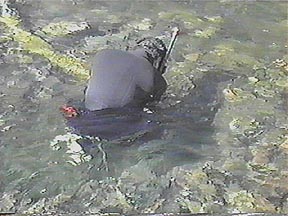 gravel
is very shallow here so there is no way the get a hole down to get you
out of the current. I was wearing 70 lbs of lead and bracing myself and
still this was a difficult place to work. If the water would stay this
low I could build myself a rock dam to get behind and be protected from
the current. Unfortunately this was the last time that I would see the
water low enough in this spot to work it. The pic above on the
left is my friend Helio Zwi dredging on the inside bend when we first
prospected this part of the river. We did not have air on the dredge at
this time, he was using a snorkel and a wetsuit. With the wetsuit
we could only get a maximum of an hour work time, it was just too
cold.
gravel
is very shallow here so there is no way the get a hole down to get you
out of the current. I was wearing 70 lbs of lead and bracing myself and
still this was a difficult place to work. If the water would stay this
low I could build myself a rock dam to get behind and be protected from
the current. Unfortunately this was the last time that I would see the
water low enough in this spot to work it. The pic above on the
left is my friend Helio Zwi dredging on the inside bend when we first
prospected this part of the river. We did not have air on the dredge at
this time, he was using a snorkel and a wetsuit. With the wetsuit
we could only get a maximum of an hour work time, it was just too
cold.