|


Trapping, although not considered "politically
correct" today, has been a mainstay of my winter life here in the
Interior of Alaska. There are many arguments both pro and con
considering the ethics of trapping. I am familiar with them all and it
is not my purpose here to argue the point, suffice to say that I number
myself among the many who have gone before me. I refer to those that
first opened up the great expanses west of the Mississippi. They were,
for the most part, trappers. They went into the wild unexplored places
and braved cold, Indians, starvation, loneliness and yes, sometimes
death. I do not delude myself by thinking that they did it for the
benefit of mankind, or to open up the west. Nor did they do it for the
fur as history tries to record. They did it for the adventure, the
danger, the need to see what was over the next hill.
For the most part the day of the trapper/mountain man
is over....for the most part. But here in Alaska there still
remains the possibility of some small semblance of that lifestyle of long
ago. There are still places here that a person can live a subsistence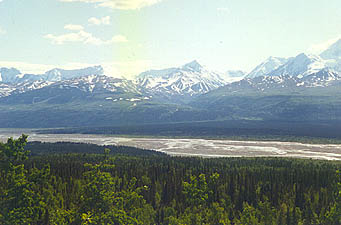 lifestyle free of the trappings of civilization. I have chosen the best
of both worlds. When I arrived in Alaska in 1973 my plan was to live a
wilderness lifestyle....but I was unprepared and Alaska is very
unforgiving to the unprepared. Alaska is not like any place you are used
to, when you leave the city here you are not in "the country",
you are in wilderness. The wilderness crowds right up to the highways
and cities and stretches for hundreds of miles in any direction. I live
near Fairbanks, Alaska's second largest city. It is about a thirty
minute drive from town to my house in a very small community. On the
drive to my house, if you were able to turn and go north you would only
cross one small gravel road all the way to the Arctic Ocean, over 400
miles. If you could turn south you would cross one major highway about
ten miles out and then it would be over 400 miles to the gulf of Alaska
and nothing but wilderness in between. There is nothing in the lower 48
states that can prepare a person for the vast expanses of Alaska or the
wild places inhabited only by moose, bears and caribou....no people, no
"services", none of the frills of civilization. In Alaska, all
roads dead end except one which is the access to Canada and the rest of
the U.S.
lifestyle free of the trappings of civilization. I have chosen the best
of both worlds. When I arrived in Alaska in 1973 my plan was to live a
wilderness lifestyle....but I was unprepared and Alaska is very
unforgiving to the unprepared. Alaska is not like any place you are used
to, when you leave the city here you are not in "the country",
you are in wilderness. The wilderness crowds right up to the highways
and cities and stretches for hundreds of miles in any direction. I live
near Fairbanks, Alaska's second largest city. It is about a thirty
minute drive from town to my house in a very small community. On the
drive to my house, if you were able to turn and go north you would only
cross one small gravel road all the way to the Arctic Ocean, over 400
miles. If you could turn south you would cross one major highway about
ten miles out and then it would be over 400 miles to the gulf of Alaska
and nothing but wilderness in between. There is nothing in the lower 48
states that can prepare a person for the vast expanses of Alaska or the
wild places inhabited only by moose, bears and caribou....no people, no
"services", none of the frills of civilization. In Alaska, all
roads dead end except one which is the access to Canada and the rest of
the U.S. 
Wolves
in Alaska, unlike the other states are far from endangered. Even though
they are trapped, they continue to thrive because of the vast areas of
true wilderness. Wolves  love
the solitary places, but occasionally, when their food source dwindles,
they will approach the small outer communities and take dogs. There is
no dog that is a match for a wolf, they are very large and incredibly
powerful, their jaws can easily snap the thigh bone of a moose. It is
almost impossible to trap wolves when they are near people because the
same set that will take a wolf will also take a dog. My wolf trapping
has been confined solely to areas far from any people. When I first came
to Alaska, the road that is the main supply to the Prudhoe Bay oilfields
was newly constructed and only went to the Yukon river, construction was
held up for several years due to environmental concerns. It was not
maintained and traversed some very wild unpopulated country. In those
years I trapped on Hess Creek, we would have to chain up the old
military Power Wagon and break through the drifts for 30 miles. We made
road sets along the way for Lynx and Marten, then unloaded the
snowmobiles for the trip down Hess Creek where our main trap-line was.
If you got in trouble here, no one was going to come and help, because
no one traveled this road. love
the solitary places, but occasionally, when their food source dwindles,
they will approach the small outer communities and take dogs. There is
no dog that is a match for a wolf, they are very large and incredibly
powerful, their jaws can easily snap the thigh bone of a moose. It is
almost impossible to trap wolves when they are near people because the
same set that will take a wolf will also take a dog. My wolf trapping
has been confined solely to areas far from any people. When I first came
to Alaska, the road that is the main supply to the Prudhoe Bay oilfields
was newly constructed and only went to the Yukon river, construction was
held up for several years due to environmental concerns. It was not
maintained and traversed some very wild unpopulated country. In those
years I trapped on Hess Creek, we would have to chain up the old
military Power Wagon and break through the drifts for 30 miles. We made
road sets along the way for Lynx and Marten, then unloaded the
snowmobiles for the trip down Hess Creek where our main trap-line was.
If you got in trouble here, no one was going to come and help, because
no one traveled this road. The fur in the picture above
was taken in one trip, It was the best results we ever had at one time
on this trap-line. In the picture are 5 Lynx, 1 Wolverine, one Wolf. We
also took a Mink that is not pictured. Notice the size of the wolf's
head compared to mine. This was a very large wolf (about 150 lbs). I
could not even hold him up too high for the photo. He was taken in a
"blind set" at a urine post that he used every time he came
through the area. The trap was simply embedded in one of his tracks and
attached to a large diameter 6' green birch log.......worked like a
charm. He pulled that heavy log about 200 yards before getting it tangled
up in a bunch of blown-down trees, and even then he as able to snap the
smaller trees like tooth-picks.

Come and visit!
The author is a
member of

Copyright 2004

Alaska
Internet Resources
|
