
|
Dredging
the Outside Bend
There
have been lots of books written on the subject of where gold will
accumulate in a creek or river. For the most part they are
all correct and well researched. The information that they contain is
right on the money and has been proven time and again by thorough and
persistent sampling. This post is not meant to be a rehash of what has
been well documented previously, nor will it be.
But
I stray too far from the purpose of this post, just consider the last
part an extra. I began my sampling in the normal way; behind
large boulders, fallen trees, low pressure areas, and of course the
inside bends of the river. The result was……a few specks of fine
gold. In mid July I moved to a section of river about 8 miles up stream
where the river narrowed down and made a 90 degree turn. The middle of
the river was swept bedrock (uncommon on this river). I began We had very little rain last summer and there came a time when it was a fight to just get the boat to the dredging area. I was running out of ideas and decided to do something unconventional. With the water level being extremely low I decided to try the fast water in the middle of the river, (actually the outside bend) It was a fight to get the dredge positioned in the fast water but I finally accomplished it. The big problem was, I could hardly keep from being swept away by the current. The low water conditions helped and even though this was the gut of the river, the water was only 3’ deep. I found that I could use some boulders to brace my feet against and by laying horizontal in the water I could reach the bottom. The only thing was, this was very tiring and I was only able to work for about two hours because of the constant battering of the current. In that time I was able to work the bedrock with the aid of a "wonder bar" as there was very little gravel to move.
So,
you might ask, what is the purpose of this post other than a narrative
of one persons dredging venture? It is just this: You have
heard the phrase over and over again, "Gold is where you find
it", it seems like every book you read has this statement in it.
But last season I came to understand that this is one basic that needs
to be firmly implanted in the mind of every prospector, and in that
respect, it can never be repeated too often. This stringer was where it
was not supposed to be, and it contained nuggets that were not supposed
to be there. When it comes to gold prospecting, never take anything for
granted, check it out. Some of the best finds in prospecting or treasure
hunting have come about because somebody did the unconventional and
looked where nobody else would. It could be that this river that I am on is different than most, for one thing there is not much grade to it, and no white water to speak of. Like most of the rivers in the interior of Alaska it winds through the countryside like a snake, doubling back on itself time and again so the flow is minimal. Even in flood stage it does not turn into a raging torrent like the rivers in Oregon or Calif. It seems to me that in this kind of a situation the gold will travel in the main current and very rarely is it picked up by the water force but rather, is pushed along the bedrock until it meets an obstacle or lack water pressure drops it. I have heard from a prospector friend in another state this fall who had much the same experience that I did, his stringer was also found on the outside bend in very fast water, 100 lbs. of lead could not hold him in place. So I guess the lesson is: Take nothing for granted, look for the obvious but be prepared to do the unconventional, and sample…sample…sample. So then, where's the beef? (gold) gold is where you find it..... |
 My
dredging operation last season was on a river here in Alaska that had
been mined by large and small scale operators for
My
dredging operation last season was on a river here in Alaska that had
been mined by large and small scale operators for 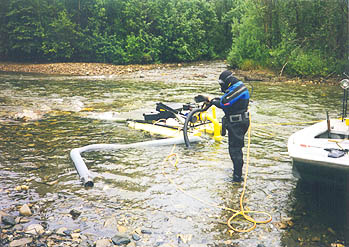 sampling on the inside of the bend and about 40 yds. downstream from it.
The deepest gravel was 2’ and by poking a series of holes I could see
where the gold was the best and trace it back to where is began to show
a decrease in gold. But try as I might, I could not find a place where
it accumulated enough to be called a paying stringer. The best I could
do was about 2 dwt per day. This was a text book situation, I reasoned
that if there was gold in paying quantities in this river, it had to be
in this spot. And this is the real reason for this post, I could have
said it in a lot fewer words, but it is cold and dark
outside……..-55F and 2pm. and I need something to while away the
time. (grin)
sampling on the inside of the bend and about 40 yds. downstream from it.
The deepest gravel was 2’ and by poking a series of holes I could see
where the gold was the best and trace it back to where is began to show
a decrease in gold. But try as I might, I could not find a place where
it accumulated enough to be called a paying stringer. The best I could
do was about 2 dwt per day. This was a text book situation, I reasoned
that if there was gold in paying quantities in this river, it had to be
in this spot. And this is the real reason for this post, I could have
said it in a lot fewer words, but it is cold and dark
outside……..-55F and 2pm. and I need something to while away the
time. (grin) 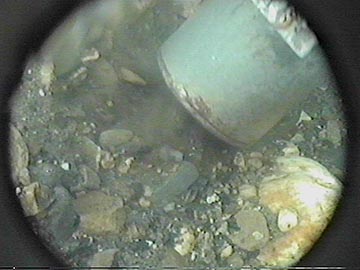 Here,
in this spot where all the text books say the gold does not usually
travel or get caught up, was what I had come to find, GOLD. In the two
hours that I got to work the bedrock I took out a little over 3 dwt. of
coarse flakes and worn nuggets. Now I know this does not sound like a
lot but remember, I was only able to work for two hours. If I could have
worked it for the normal 6 hrs. that I usually worked I would have come
away with almost an ounce. The nuggets were a surprise because they were
not supposed to be there according to all my research.
Here,
in this spot where all the text books say the gold does not usually
travel or get caught up, was what I had come to find, GOLD. In the two
hours that I got to work the bedrock I took out a little over 3 dwt. of
coarse flakes and worn nuggets. Now I know this does not sound like a
lot but remember, I was only able to work for two hours. If I could have
worked it for the normal 6 hrs. that I usually worked I would have come
away with almost an ounce. The nuggets were a surprise because they were
not supposed to be there according to all my research.