|
The Scoop on
Prospecting in Alaska
Written By: Marcie Foley
I’m sure there are many of you who have heard of magnificent finds in Alaska, and there
have been many. I wanted to come to Alaska to dredge, for many years. When I finally
came here, it wasn’t because of the dredging, and although I have not done a whole lot of
prospecting since I arrived, I do stay in contact with a lot of people who are prospectors, so I
have made some observations and notes that will help anyone who IS planning to make that
dream a reality.
Remember how places where gold is found are sometimes different? If your prospecting has
been confined to the mother lode area of California, you won’t find much difference.
However, if you go a bit further, to the Klamath River in far northern California, you’re
presented with a situation where you have to change techniques. In the mother lode, streams
are confined to steep drops in rugged mountains, and the gold is mostly found on or near
bedrock, which is pretty shallow. On the Klamath, a much larger river, the gravels can be up
to 30 feet deep, and the gold that is mostly found is found within a “pay layer” deposited by a
flood. Most of the gold found is of a small flake or small nugget variety, with larger pieces
being rare.
Well, Alaska is another whole ball game. And not only that, Alaska is soooooo large that
there are several different ballgames WITHIN the state!
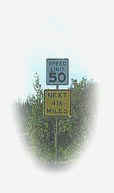 First, you have to really realize how HUGE the state is. I guess because when you are in the
“lower 48” about the only time you see the state of Alaska it is separated on a weather map,
and sitting down in the ocean somewhere off the west coast, and is not done to scale so you
really have no idea of the size. Alaska is two and a half times the size of Texas… Now that is
big! And the topography changes a great deal within the state, so there are a number of very
distinct and different areas.
First, you have to really realize how HUGE the state is. I guess because when you are in the
“lower 48” about the only time you see the state of Alaska it is separated on a weather map,
and sitting down in the ocean somewhere off the west coast, and is not done to scale so you
really have no idea of the size. Alaska is two and a half times the size of Texas… Now that is
big! And the topography changes a great deal within the state, so there are a number of very
distinct and different areas.
Second, another thing different about Alaska is that “there are no roads.” That is local
terminology, but it is very true that there are few roads in the state, and many mining areas
are either completely cut off from road access, or the distances are so great that they are
difficult to get to. So, access to a mining area is sometimes difficult, and it is not always
possible to go from one area to another. What you want to do, and where, needs to be worked
out ahead of time, or you may get up here planning to do everything in your pickup and
camper and need a plane to get where you want to go, and spoil your whole trip.
Third, just in case you are planning to camp out in a tent… if you are picturing the forests
of the western states, where you drive in, find back roads near campgrounds and facilities
like stores, gas stations, etc., and can throw up a tent and dredge right outside your door,
you need to think again. That is not the reality of Alaska. At least not anywhere near my
area, and anywhere north of here. The reality is this:
Much of Alaska has already been made inaccessible to most of us. There are no roads or
trails, and you can’t make them. There are huge wilderness areas, large blocks of land which
belong to native corporations, and large blocks of land that are government controlled to the
point where access for recreational prospecting is not possible. You need to make sure that
you can even do whatever it is you plan to do.
Now, if you find out you CAN do whatever, and wherever, then you need to realize that this
is like no forest in the lower 48. It even has a different name… it is a Boreal Forest, because
of the location, but what you are concerned with is the fact that I have been on all of the major
roads leading north from here, and it is hard to imagine the miles and miles of unbroken
forest, leading to the horizon in every direction that goes on forever. You get out of your
vehicle and you are faced with an impenetrable wall of forest at the road’s edge. You can’t
insert more than a hand in many places, let alone put your body into it and walk. It
requires a machete to hack a trail every step of the way. Let me tell you… the men who first
explored this land were tough! And if you could hack your way into it, or head up or down a
river and get somewhere you wanted to be, where would you be? How long would you be able to
stay there? Could you survive? If you were alone, and were in a tent, that is very debatable.
This is not like any area you have been in the lower 48 states. It is not your world out there,
it is a true wilderness where animals are at home and you are the interloper… you are at the
disadvantage. You do not know the game or the rules. The game? It is survival, and there
are NO rules. If you step into a bear’s territory, and he wants to, he will eat you. If you face a
moose and he is having a bad day, he will stomp you. If you miscalculate and don’t have
enough food, or a bear chomps your gas cans or boat, or any number of other things that can
happen… and you can’t get out, you will die. The sad fact is that people disappear in Alaska
every year, and no one ever finds them, no one ever knows what happened to them. It is a
very large place and wherever you are is a very small spot, and most often unknown by
anyone else.
The first rule of Alaska is that you never go into the bush alone. Even seasoned sourdoughs
(those who are knowledgeable), do not go alone without leaving word of exactly where, and
how long, with someone with the means to get them out. You will be dependent on machinery,
and it can break down, ALWAYS. And even if not alone, you ALWAYS leave word, and
keep in contact with them. If you stay in a tent, you have to know what you are doing. There
are a LOT of bears up here, and they are all hungry. How many? No one has any idea. It is a
huge wilderness… a true wilderness. Bears are territorial, and if you plunk yourself down in
a bear’s territory, well… or if he gets hungry and starts roaming and there you are, well…
So I am going to talk a bit about the area where I live, in the Fairbanks area, and then tell
you what I have learned about the other areas, in talking with other prospectors here. Jim and I
put up an “Alaska Gold Forum” on our website, and for the first time, prospectors from
around the state are having some contact with one another.
The general topography of the Fairbanks, Livengood, and nearby mining districts is of river
valleys, and low rolling hills. In the immediate areas around Fairbanks where gold has been
found, there are a number of very large mining companies, and there are smaller ones, down
to one-man operations. These are commercial operations. There are no recreational dredging
areas within the city or the immediate area. There are miles of tailings from large dredging
operations, which were successful, and the commercial operations are successful because they
can access the gold, which is deep. Mostly 30 to 60 feet deep, and more. There are several
commercial panning operations in and around Fairbanks where you are given a pan of
material that they have removed from deep inside a mine, and pan for a fee.
Because there are no large mountains, steep drops to the creeks, etc., they do not look like the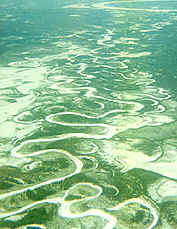
creeks in the mother lode area of California. These creeks and rivers are meandering slowly,
and twist and turn constantly as they slowly make their way to larger rivers. There are not
large concentrations of big boulders, as there is no fast water to move them.
The first dredging water to the north of here is in the Chatanika River, and in the area of the
campground that is accessible to the road, it does not look very promising. I have not
actually done any panning there, but no bedrock is in evidence, nor large boulders. There’s a
lot of gravel. There are other areas further up this river where access could be possible, mostly
created by hunters during moose hunting season. The river runs fairly near the road. We are
going to check that out, and locate a gravel pit that a prospector told us about. Finding the
right one is the problem… there are a lot of them, used to construct the roads. And many of
them are filled with at least some water during part of the year.
Waders are another necessity here for exploring. Much of the ground is muskeg… it is not
solid. It is tufts of grass sitting on pretty much “mush,” or ground that has permafrost that
melts at the surface in summer, so it sinks when it is walked on. I have not been in it… yet.
We have confined our walking to dry areas.
For a newcomer, a book written by Ron Wendt, called “Where to Look for Gold in Alaska
Without Getting Shot” would be a necessity. Ron comes from a family of prospectors, and
was born in the Fairbanks area. He has researched gold prospecting perhaps more thoroughly
than anyone in the state, and is a wealth of information, having worked most every mining
district from the fortymile down to the Anchorage area. Ron gives you page after page of
places that are highway accessible, for a number of areas in the state, and rates them as to
what you can expect to find, what equipment can be used there, etc.
Further north there are a number of large mining districts. Near the top of Eagle Summit
are Harrison and Mastodon Creeks (now when I was dreaming of Alaska, I sort of featured
Mastodon Creek as about 5 miles outside Fairbanks… but it is actually too far to reach in a
day, do some prospecting, and get back home. And the road, the Steese Highway, is mostly
gravel. While it is a good gravel road, the gravel is sharp, and it is not unusual to hear of
someone losing one, or even two tires on a trip. It is pretty heavily traveled, as it is the only
road to a number of small towns to the north. Manley Hot Springs, indirectly, and Central
and Circle City direct, where the road ends at the Yukon River.
Harrison Creek and Mastodon Creek are in steep country, and Harrison Creek is famous for
nice nuggets, as is Mastodon. We have a friend with a claim on Harrison Creek, and have
worked there a bit. As in most places, there is nowhere to work on either creek, they are
entirely claimed and worked very hard by a number of mostly small commercial operations.
Further north at Central, you can turn off to the Circle Mining District, which is on the road
leading to Circle Hot Springs. GPAA has some new claims on Deadwood Creek there that we
hope to work this summer. From what Ron says, and from the articles he has written about
that area, it is mostly worked with small commercial operations now also. I gather that the
best gold would be further up Deadwood Creek, but he says there should be good areas possible
on the claims. Note: This area is known for mosquitoes… you heard of them, of course. The
Alaskan mosquito, the state bird? (A local joke) While I have not been back in to the claims, I
have gone to the miner’s picnic in Central, on a damp, rainy summer day when clouds of
them hovered around our heads. You need to have plenty of “bug dope” before venturing out
into the bush in Alaska.
After leaving Central, the ground gradually slopes down toward the Yukon River, which is a
very large river! Where the road meets it at Circle City is one of the narrower places, as it has
been confined to a space between two bluffs. Downriver from here it opens up to form many
rivers, and gets incredibly wide and spread out. There is no road access to the Yukon after it
leaves here, I don’t think. There are native villages between here and the coast, and there are
still riverboats that supply them. Their only other access to the outer world is by plane, or dog
sled in winter. They use snow-machines to access other nearby villages, but not for long
trips. I did not see any evidences of mining in the Circle City area. They may be there, but
they are not evident from the highway, if they are. The town was much smaller than I
expected. I had only seen photos taken during the original development during their gold
rush, and it is smaller now than it was then.
Another invaluable tool for someone coming to Alaska is “The Milepost.” This large book
covers every highway leading to Alaska from the lower 48… it will take you all the way from
the border there, to Alaska, and then covers all major highways in Alaska and some in the
Yukon, mile for mile, telling you just what to expect from the highway, and what can be
found along the highway. It is very good. Of course it does not cover all the prospecting
areas, or areas from a prospecting angle. But it is something I would not want to be without
in unknown areas.
Other mining districts to the north are partially accessible by the “haul” road… this is the
road used to access the oil pipeline. The Brooks Range is an area to the north that is rich in
gold. It is NOT directly accessible by road, however. The people mining in the Brooks range
fly in. This area is hundreds of miles to the north of Fairbanks, and I do not have any
information on it. It is not a recreational area. The access is too difficult, and I don’t even
know about any other problems involved. The Koyukuk River has been mentioned by my
husband on his website, and in an article he wrote. He has done a bit of prospecting there, and
it is still dredged in some areas. Some of it has been closed recently. This area is about 200
miles north of Fairbanks by this gravel road, and then you must have river transportation
with you (there is only a bridge there, no facilities anywhere), as it is several miles by river to
the dredging area he spoke of. You must also be able to transport with you by river, your
prospecting equipment. The Wiseman mining district is also up this road even further, and
Coldfoot. There are rich mining districts in these areas, but the mining districts are not
accessible by road. Towns are, but I don’t even have mileages at my fingertips right now.
They are a long way. There are commercial operations up there, some fairly large.
To the southeast, on the Richardson Highway, is Delta Junction, and there are some large
mining operations in this area, but no recreational prospecting that I am aware of.
Further south we have begun to investigate the Black Rapids area. This is an area several
hours south of us on the Parks Highway, which leads to the coast at Valdez. Valdez is about
eight hours south of us by highway, depending on what work is being done to the road. To
give you an idea, they say there are four seasons here… almost winter, winter, still winter,
and road construction. Typically, they will be working on the road in several places, all the
time that construction is possible. There are not many months of the year that the ground is
not frozen, and while it is, the elements are wreaking havoc to it. So they have to repair it,
every year. It slows travel down during summer months. This is a gorgeous drive, however,
and there is tremendous fishing at Valdez, in a most beautiful setting.
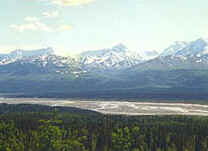 In a mountainous area, at Black Rapids there are a number of small creeks that tumble down
steep mountainsides to flow right under the highway. We had a little luck panning one, and
less dredging another with a small dredge, but after talking to Ron about them we think we
can have some better luck at others. There is a military facility in this area that you must
deal with. The land continues to slope steeply from the highway to the river not far below at
the lowest point in this valley, and a glacier is seen flowing from the pass on the other side of
the valley. There are a number of creeks flowing into the river from the other side, also, but
prospecting is not allowed there. Full of glacial silt, the river is not suitable for dredging.
The water appears to have the consistency of gritty cocoa, and the color is the
gray of concrete
in these glacial rivers and streams.
Although the creeks are small most of the year, we checked them out right after flooding last
year, and they moved a whole lot of material at that time! They were forced to do a lot of
reconstruction to the area, and the highway was closed for several days while they cleared
away all the debris that ended on top of it. Since it is quite a distance it will take awhile to
thoroughly check it. We can do it in a day, but it does not leave us a very long day working
there. We may rig up something so we can “overnight it” in our minivan, but may not be able
to do that this summer. We have a lot of company coming this year.
Further south on the Parks highway from Fairbanks, the mining areas are not far from
Anchorage. Anchorage is about seven hours by highway. There is the Petersburg mining
district, and/or the Yentna mining district (I haven’t figured out yet if these are separate or
one and the same), which is in the mountains near Wasilla (about an hour this side of
Anchorage). There is some dredging in this area, and Dennis Garrett, who has a commercial
operation, is offering prospecting trips, or fees, or claims or something. You can often ask for
him on our forum and he’ll reply. Or you can go to his website, and I’ve included that url on
the Prospecting page of this website.
Then, to the south of Anchorage on the Sterling Hwy I believe, toward the Kenai Peninsula, as
you go around Turnagain Arm there is a mining district to the left called Crow Creek, where
a commercial operation offers mining by the day on their claims. This is a popular place for
detectorists and dredgers and panners in the area, and they sometimes can do quite well.
GPAA also has claims in this area, somewhere (on Mills Creek?), that co be good. Near the
end of Turnagain Arm is a turnoff to Hope, to the right. The Hope Mining company has
commercial claims there, and was offering mining packages to people, also. I do not know
anyone who has mined there. It is rich in gold mining history, I just don’t have any
feedback on this company from anyone yet. If anyone visiting this page does have firsthand
knowledge… have experienced it for themselves, could you please email me? Thanks!
There are hardrock mines in the steep mountains around Moose Pass, going further south on
the Sterling Highway. Very steep country and stiffly regulated, I understand. I have a book
all about gold mining on the Kenai Peninsula, that was given to me by a friend there, Eric
Treider. I have not read all of it yet, however, so I will hold off on going any further south
with my information.
I do understand, from the dredgers who visit our gold forum, that in some areas to the south
of us, they prefer dredging in the winter, because the water is too swift during summer
months in some areas. They have posted a lot of photos of dredging when deep snow is on the
ground. That is dedication!
Marcie Foley is the former
managing editor of
Gold and Treasure Hunter Magazine
as well as the co-owner and general manager
of Pro Mack Mining Supplies.
Back
|
