|
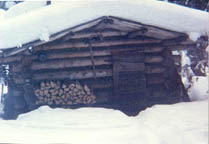
August Lohi was a retired Chicago cab driver. He came into the valley of the East Fork in 1950 with two partners. They came for the purpose of prospecting for gold. After a period of time there was a disagreement between the partners and they split up. The other two left to prospect in another district. August stayed on and built a cabin that others would come to call, "main camp," and another cabin which he used as a storehouse. The cabin site was on xxxxxx creek near the confluence of the East Fork. The storehouse was filled with his supply of food, as well as food for his dogs, and all the supplies that he would need for the year. Among these supplies was a vast array of tools, all new. The main cabin layout consists of a basement about 5’ high with a dirt floor and a ground level living space, which is about 12’x16’, with a wood floor and a partial loft above. This is the only cabin that he ever built with windows (2). He also built other cabins, one at the junction of Munson and Wheeler Creeks, and another farther up Wheeler Creek. (This last one burned down in a forest fire.) He also built four others along the East Fork. One is just before Ottertail Cr. in a stand of large Spruce on the south side of the river, about 100 yd. from the river. The second one is just before Blackshell Cr, also in a stand of large Spruce, on the south side of the river. This one is on the bank of a small diversion of the river. The third one is just before Teuchete Cr., in a stand of large spruce on the south side, and about 100 yd. from the river. The last one is just before Van Curlers Bar, about 100 yd. off the river on the south side. There are other cabins scattered over the valley of the East Fork but it is not known if they were built by August. None of his cabins are spaced far enough apart to be used for trapping cabins. They are, however, just right for a secure sleeping place while mining (he was terrified of bears). He also built a system of trails that were well marked with blazes. These trails show signs of
It is my belief that his main endeavor was prospecting and that trapping was secondary to this. He did trap extensively and was very good at it, concentrating mostly on wolves and marten. There are the remains of old wolf (moose and bear) snares along all the trails. I added moose and bear because some of the trees that the snares are fastened to show signs of having had a bear in them. It is known that he was hard on the moose population, using them for wolf bait as well as his food. It is thought that he left his snares set through the summer in the hopes that they might take any bear that happened by. He had instances of having a bear jump in the middle of his dogs while traveling. This would only be possible in the warm months. He was known to shoot any bear on sight. In the middle seventies August was befriended by a man named Gary Howard. Gary had a plane and it was a simple matter to fly in to visit at various times. As their friendship developed, Gary made known to August his desire to buy the main cabin and the five patented acres it was on. August was reluctant to sell because he wanted to live there until he died. Gary had a legal instrument drawn up to the effect that he would make payments to August while he was alive, and when he died the property would be deeded over to Gary. Some time after this, Gary and August had a disagreement, whereby August asked Gary to leave at the point of a gun. After this incident, there was always a blockade on the airstrip to keep Gary from landing. I don’t think they ever communicated again. August was a tireless worker. He maintained his trail system and trap lines, built cabins, prospected, and cut enormous quantities of firewood. His firewood was all cut by hand with a bow saw. There was a large pile of firewood at each cabin (by large I mean three to four cords). Main camp was the exception. There he had at least forty cords cut and stacked. Each cabin was fully stocked with food, saw, ax, shovel, and a wood stove. Each cabin also had a variety of hand tools. The Ottertail cabin is the only cabin with a gravel.........floor??? There is no gravel in the immediate vicinity of the cabin, it all had to be hauled in, WHY? All the other cabins have a dirt floor. The ground is not even wet here. I have found shovels and gold pans at various places along the trails, usually next to a stream. In one place on Munson Creek I found a shovel standing beside a path that had been carved into the side of a hill. The path had been built by first laying down spruce poles as a base, and then caving in the side of the hill on top of them to form a path. This hill is very steep and comes right down to the creek. The path made it possible to avoid crossing the creek to get around the hill. This shows me that this trail was well traveled, and used in the summer. That path was a lot of work!!! There are signs that August’s age was catching up with him, and his health was starting to fail. He began to pull back his activities from the harder-to-reach cabins, and concentrated his efforts closer to Main camp. He doggedly stayed on at Main camp until his eyesight was almost gone. In desperation he built a raft of logs and attempted to float down the East Fork to the road. This was September of 1978. He never made it to the road. His raft got hung up and dumped him in the river. Almost blind, and with nothing but the clothes on his back, he stumbled into a hunting camp set up by two men who were moose hunting. They brought him back to town where he was treated at the hospital. After his release from the hospital his sister convinced him to return to where she lived so she could take care of him. He agreed to return to be with his sister where he died within a short time. After August Lohi died, Gary Howard took ownership of Main camp and its five patented acres, along with everything that August had left there. I accompanied Gary on a flight into the cabin to help him load some of the things that had belonged to August. One of the things that we hauled out was a core drill that Gary said cost about $10,000. It was new and still packed in its original box. There were many traps of all sizes, tools and supplies of all descriptions, as well as all of August’s dogs. The rest of this narrative is not in chronological order. It is a record of my observations and research, as well as things told to me by others; although, for the most part, people did not know very much about August Lohi. I have included all that I have observed, no matter how insignificant. After all, if the mystery is solved, some of these things may take on significance. There are three holes that have been dug on the trail between main camp and the winter trail. They are about 3x6’ and are caved in now. They were obviously dug some time ago. They are consistent with other holes that I have seen that were obviously the result of prospecting. When approaching Munson creek from the east, you can see a hill on the west side of Munson to the southeast, that has a "gunsight" notch in the treeline on top of the hill. This anomaly has puzzled those that have seen it over the years, but no one could explain it. I have always had the idea that August was where he was for the purpose of prospecting. This interested me because I was also interested in prospecting. I was also curious about what I considered, 'the mystery of the old man.' I thought it would be fun to try to unravel the 'mystery.' I began at the office of land records--it is here that any record of mineral claims would be kept. Bingo!!! I found that August Lohi had filed location notices for two different prospecting sites. They were both at the confluence of Munson creek and the East Fork. They were standard 2,640 ft. state claims. One was named, "Mable #1," and the other was named, "Hazel #2." Both claims were filed on March 23, 1976, and there is no record of annual labor performed. This would have to have been done in order for the claims to be legal in any subsequent years. There is no sign of any work ever having been done on these claims. Is it coincidence that these claims were filed just two years before they would have been included in a state recreation area? Mining is not allowed in a rec. area. I also found that he had filed four lode claims in August of 1974. Their location would solve one mystery. They were located on top of the hill with the "gunsight" notch. He had named them Zenaphon #1, Xenta #2, Xestus #3, Xerxes #4, respectively.He also filed an affidavit of annual labor for the year 1975. The affidavit shows substantial trenching work performed. I had occasion to visit these claims in 1983 along with Bill Huhn, a friend. What follows is a detailed account of what we saw. The first thing I did was to purchase an infra-red satellite photo. On this photo I could see the faint outline of what looked like a foot trail leading from the main cat trail to the hill where the claims were. The photo also showed the cleared area on top of the hill, but that was as much detail as I could see with the aid of a 10x loupe. In the spring of 1983 Bill and I took our jet boat up to the main camp, and from there we hiked the trail to the main cat trail. There were still patches of snow on the ground. When we reached the cat trail we looked around for any sign of the trail that I had seen in the ir-photo. We found a blaze on a tree that was very old and by careful observation we were able to find more blazes leading in to the hill. There was a small creek at the base of the hill, and to our surprise, on a small rise of the creek bank there stood the remains of a large teepee. The
At the time, we had no idea that there was a trail up the hill on the north side, facing the creek. We circled the hill to the west looking for the easiest way up. We climbed the west side of the hill. It was a very steep ascent. When we were almost to the top I came upon a cleared brush-line, obviously the west boundary of the claim. In following the boundary, we came upon what seemed to be a crude sighting device consisting of two Black Spruce about one foot apart, with wire strung between them and a stick twisted into the wire. We continued, skirting the perimeter of the claims until we came to the cleared area on top of the hill. The cleared area is about ½ acre in size. Every tree and bush had been removed, including the roots. Everything had been thrown over the edge of the cliff on the east side of the hill. What an amazing amount of work had been done here. Search as we might, we could not find any tools. It is hard to imagine August, at his age, hauling those picks and shovels up and down that hill. There was nothing else to be seen on the top of that hill except a beautiful view of the valley below. When we left, we followed the eastern boundary of the claim northward until we came to a trail that led down the spine of the ridge on the north side. At regular intervals along the trail we found where August had dug holes about 3x6’ and about 18" deep. The purpose was to take bedrock samples. We never did find a discovery location on that ridge, but I believe that he found some lode gold. These claims were also in the rec. area. At the time he filed on them, I think that he knew that they would be included in the rec. area and his claim would have grandfather rights. These are the only claims that he ever filed on, but only because he was forced to by circumstances. They were claimed late in his life. What about the other 20-25 years that he spent in the valley? I think that he found at least enough to get by on over the years. He probably worked placer diggings because lode gold was too hard to mine by hand. There are cabin remains about ¾ of the way up Blackshell Creek. Years ago it would have stood on the creek bank, but now the creek has cut a channel on both sides of the cabin, creating an island. I suspect that this was one of August’s cabins but there is no way to tell for sure. One thing is certain: the cabin was there for the purpose of prospecting. This is a very small creek and valley, well off the beaten track to anywhere, and it dead-ends about six miles in. August was noted for blazing trees everywhere he went, even when he was traveling a well worn trail that he traveled frequently. There are blaze marks that can be seen randomly along this creek, but not frequently enough to follow. I feel fairly certain that the cabin and the blaze marks are August’s. One other reason for thinking this way is that there would be no reason to mark a trail, because the valley is so small you couldn’t get lost if you tried. Besides this, the blaze marks follow the creek except where they cut across the bends. This is all indicative of the way he did things. There are the remains of two cabins on a small slough about 17 miles in on the cat trail. This slough used to be the old channel of the East Fork, the north end of it fronts on the river. The cabins are on the left bank about 150 yd. from the cat trail. There is nothing left of these cabins--they have fallen in and been covered by vegetation. The only reason that I found them is because I stumbled on an old stove pipe when I heard my foot hit it under the grass. On closer examination, a faint outline of the base logs could be seen. There are some small pieces of wood with nails in them. This is thrown in as misc. information only. I think that from the condition of the remains, these cabins predated August Lohi. There are two odd things about these cabins, the first is; why two cabins? This was very unusual for most of the old timers. Second, why were they where they were? Other cabins that I have seen were always built in a stand of Spruce, these were built in a stand of mature Birch. This also means that all the logs for the cabins, as well as all the firewood would have to be brought from some distance away. Another enigma??? I have seen maps, letters, and brochures that belonged to August. The maps were very interesting. They show symbols and numbers hand drawn and all concentrated near the head of Touchette Creek. Some of the symbols are on the ridges, but two are down in the creek bottom itself. Based on this map, I purchased an infra-red photo of the location. The photo seems to show an unusual amount of gravel, or at least a place with no vegetation covering rock of some kind. Rocks and gravel show up white in the ir- photos. This corresponds, location wise, to the symbols on the map. This is the only time, (that I know of) that symbols this clear were put on a map by him. I feel very strongly that he did some mining in this spot. There has to be a good reason to mark this spot on the map. It must have been important, at least to him. This location is very difficult to get to. It would probably take a day or more to hike in. It is located about 7/8 of the way toward the headwaters of Touchette creek. I cannot see a cabin in the photos but cabins usually don’t show up, especially in the trees. I know exactly where the other cabins are but they cannot be seen in the photos, with the exception of Main camp. Main camp is in a clearing. One of the letters was extremely interesting also. It seems that he corresponded regularly with his niece. Of course you would never get to read what he wrote. But in one of the letters she said, "...congratulations on your good fortune, what is it... gold or uranium?" There were other letters, but none with any references of this nature. I intend to follow up on this bit of information and possibly make contact with his niece. Her address, as of the time she wrote the letter, is available through Gary Howard’s son. There were also brochures from companies who sold Geiger counters, as well as one letter from one of them answering some questions that August had obviously written about Geiger counters. I was told by Gary Howard that August had written some articles for magazines, I think that it was for Field & Stream or Sports Afield. This is another lead that I intend to follow up on, if the info is available from the publisher. Another odd thing about his cabins was that they all had galvanized metal roofing; not sod, as most old cabins had. He also made his cabins bear-proof by driving hundreds of nails into his cabin doors, pointed outward. When we were building a cabin on Blackshell Creek, I found a large Spruce tree beside a gully. If you walk around the back of this tree, on the gully side, you can see where someone cut a square hole in the trunk about 18" off the ground. The hole is about 4" square. This hole is not visible unless you enter the gully, which has steep sides. The thought that comes to my mind is, how many other hiding places like this are there in the valley of the East Fork???? Along one of his trails on the East Fork there is a place where the trail turns north to avoid a beaver pond. The pond fronts on the river. One time I left the trail to walk over to where the dam meets the river, about fifty feet. There, standing beside a large Spruce tree, was one of the old man’s short-handled shovels. There was also a pile of firewood stacked between two trees, but no other sign of any other activity. This may have been a place that he regularly prospected. The beaver dam would back up a head of water large enough to run a small sluice???? As you approach Ottertail Creek from the west, there is a trail marked out by blazes along the river. The trail starts up Ottertail Creek, but after a short time it seems to peter out; or at least, I can’t find it.
So then, this is the 'mystery of the old man'. It is the compilation of all that I have been able to find out to date. It is obvious that he was prospecting and somewhat successful at it. The question remains, then: Did he accumulate some gold? Since he left suddenly, and with nothing but the clothes on his back, did he leave a stash somewhere? It would seem likely that he did. He did not trust banks and it was common in those days for miners to stash valuables and gold somewhere close by. He was secretive enough to have done just this. Hopefully, before I become too old, I will have solved the mystery.....or made a very good try at it.


Back
Copyright
2004
|


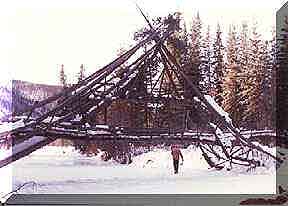
 travel by dogsled in the summer months, as they are well worn into the ground, which would not happen if they were only used in the winter. He built pole bridges at all stream crossings, with the most impressive being a suspension bridge over Munson Cr. (Photo below). These trails follow the East Fork along the south bank, and Munson Cr. along the west bank. Wheeler Cr. also has a trail along the north bank. There are also signs of trails on most of the other creeks in the valley. They are so old that they are impossible to follow.
 fabric that had covered it was in tatters, but other than that, it looked like someone had walked off and left it. The remains of the contents of the teepee were scattered about, probably by bears. I suspect that whoever had been there was prospecting. This was not something that August would put up. There was no sign of prospecting on the small creek.